
Customer effort score measures how much work a customer had to do to get their problem solved, not how happy they were afterward. It's usually a single post-interaction question ("How easy was it to handle your issue?") scored on a 5 or 7-point scale, and it predicts churn better than satisfaction does because effort is what people remember.
Most teams implement CES badly. They survey every closed ticket with the same question, average the scores, and report a number that goes up or down for reasons nobody can explain. That's not a metric, it's noise with a decimal point. Here's how to actually use it.
What is customer effort score supposed to measure?
CES was built on a simple observation from service research: customers don't need to be delighted, they need friction removed. A customer who gets a correct answer in one message and never thinks about your product again is happier than one who gets a delightful, chatty resolution after four back-and-forths and a callback.
The classic question is "On a scale of 1 to 7, how much effort did you personally have to put forth to handle your request?" Low effort, high loyalty. High effort, even with a happy ending, predicts the customer will look at competitors next renewal.
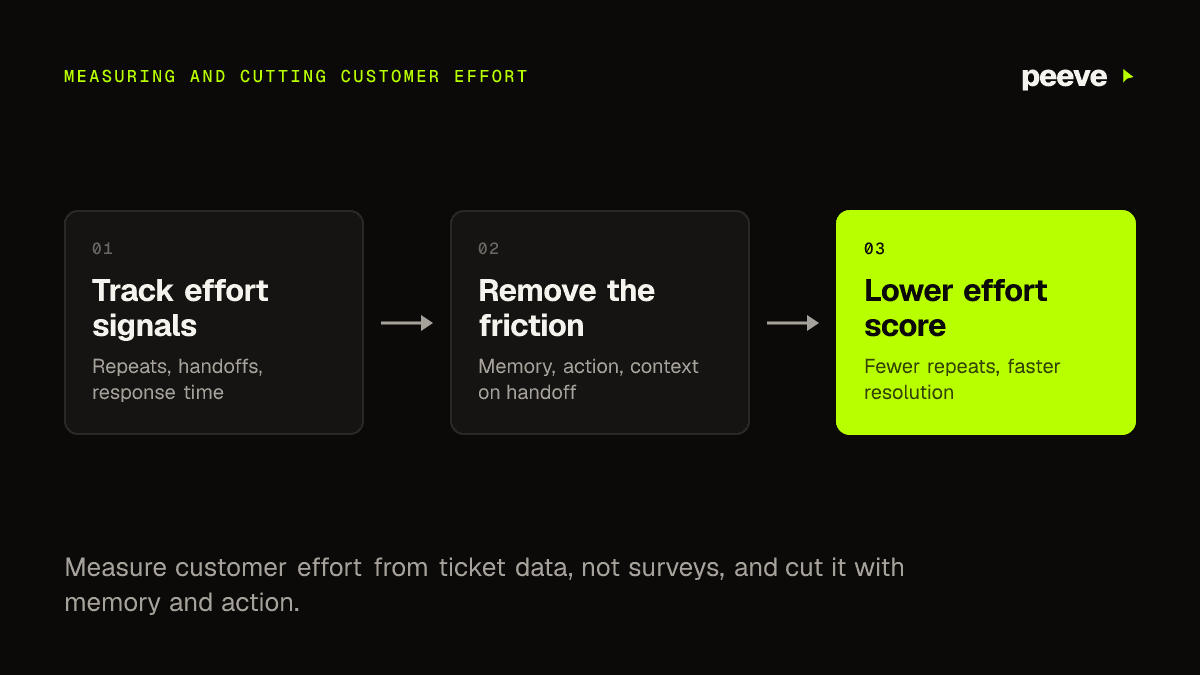
The mistake is treating CES as a vibe check. It's a proxy for something measurable: how many steps, handoffs, and context repeats did it take to close this ticket? If you can instrument that directly, you don't need to wait for a survey response, and you get it for 100% of tickets instead of the 5-10% who bother to answer a popup.
How do you measure effort without relying on surveys?
Survey response rates on CES questions are low and biased toward people who are either furious or unusually patient. If you want a number you can act on, build it from your own ticket data instead of a sentiment popup. Pull these per ticket:
- Number of messages the customer sent. Each one is the customer re-explaining or re-asking. Two or fewer is low effort.
- Number of times the customer repeated information they'd already given (account ID, error message, plan tier). This is the single biggest effort driver and the easiest to fix.
- Number of handoffs between channels or people. Chat to email to phone is three context switches, three retellings, three waits.
- Time to first useful response, not time to close. A ticket that sits for six hours before anyone replies is high effort even if the eventual answer is perfect.
- Whether the customer had to leave the product to find an answer (searching a help center, emailing support) versus getting resolved in-app.
Score each of those on your own historical tickets for a month and you'll have a real baseline, no survey required. Then segment by ticket type. "Reset my password" should score near zero on all five. "Migrate my billing seats and fix the webhook that broke" will legitimately score higher, and that's fine, the goal isn't zero effort everywhere, it's zero unnecessary effort.
Where does effort actually get added?
Almost all of it comes from three places, and none of them are the customer's fault:
- Repetition. The support rep (or bot) doesn't have context, so the customer re-explains their plan, their issue, and what they already tried. Every repeat is a point of effort and a point of rage.
- Redirection. "That's a billing question, let me transfer you" or "I can't help with that, try our help center." Each redirect resets the clock and the trust.
- Instructions instead of action. Telling someone "go to Settings > Billing > Update Payment Method" and leaving them to execute it is more effort than doing it for them, or at minimum showing them exactly where to click.
This is really an architecture problem dressed up as a satisfaction metric. If your support stack can't carry context between a chatbot and a human, or between email and chat, you will always score high on effort no matter how nice your agents are. We wrote about this gap in more detail in why most AI support tools are optimized to lie to you, the short version is that a tool optimized to close tickets fast isn't the same as a tool optimized to make tickets painless.
How do you actually lower it?
Fixing CES isn't a training problem, it's a system problem. Three concrete moves, in order of impact:
Kill repetition with memory. If a customer messaged in-app yesterday and emails today, the second conversation shouldn't start from zero. This is what a private customer memory is for: it holds what happened across the widget and email so nobody has to ask "can you remind me what plan you're on" for the third time. That's the whole idea behind the Customer Brain, and it's worth checking whether your current stack does this before you add another survey.
Replace instructions with action. Telling a customer where to click is effort. Walking them through it live, on their own screen, is close to zero effort. Doing the backend change for them, after they confirm exactly what will happen, is zero effort, and that's a bigger trust question than a UI walkthrough, which is why actions should always require explicit confirmation of the exact effect before anything executes. Note this is a capability only available on the Growth plan and up, not Starter.
Cut the handoff chain. Every transfer between a bot and a human, or between support and billing, adds a full retelling. The fix isn't "train the bot better," it's giving the handoff the entire session when it does happen, so the human picks up mid-conversation instead of starting an interrogation. That's the difference between a hand off that preserves context and one that doesn't.
This is roughly the ladder we built Peeve around: an AI customer support agent that answers with a cited source, shows the customer the exact screen when a reply isn't enough, does the backend action when the customer confirms it (Growth plan and up, never on Starter), and hands off to a person with full context when it genuinely can't help. Each rung exists specifically to remove a category of effort rather than just answer faster. You can see the whole model laid out at /product/, or get the longer explainer on how AI customer support works generally at /ai-customer-support/.
What should you do with the score once you have it?
Don't publish a company-wide CES and call it done. Break it down by ticket type and look for the ones where effort is high but the task is simple, that's your highest-leverage fix. A password reset with high effort means your flow is broken. A complex migration with high effort might just be an inherently hard task, and no metric will make that zero.
Track it over time per category, not as one blended number. And pair it with your other metrics rather than replacing them; we go through the fuller set in customer support metrics worth tracking with AI.
FAQ
What is a good customer effort score?
There's no universal good score because it depends entirely on the scale you use and the ticket type you're measuring. The more useful exercise is comparing your own score across ticket categories over time: a rising trend on simple tickets like password resets is a real problem, a stable high score on genuinely complex requests is not.
Is customer effort score better than customer satisfaction (CSAT)?
Customer effort score and CSAT measure different things: CES measures how hard the interaction was, CSAT measures how the customer felt about the outcome. Effort tends to predict renewal and churn better because customers forgive a flaw but remember friction, so most support teams should track both rather than picking one.
How often should you measure customer effort score?
Measure it continuously from ticket data (messages sent, repeats, handoffs) rather than only through periodic surveys, since survey response rates are low and skew toward extreme experiences. Review the trend monthly by ticket category so you can catch a specific flow breaking before it shows up in a quarterly report.
Does reducing ticket volume lower customer effort score?
Not necessarily. Deflecting a ticket by pointing someone to a help article they still have to search through and apply themselves can score high on effort even though it never became a ticket; effort is about the customer's work, not your headcount.
Can AI customer support actually reduce effort, or does it just add another chat window?
An AI customer support agent reduces effort only if it removes repetition and action, not if it just answers questions a help center already covered. The test is whether it remembers the customer across channels and can act on their behalf (with confirmation) instead of handing them another set of instructions to follow themselves.
What's the difference between effort and resolution time?
Resolution time measures how long a ticket stays open, effort measures how much work the customer did during that time. A ticket can close in two minutes and still score high effort if the customer had to repeat their account details twice and got transferred once; the two metrics should be tracked separately.