
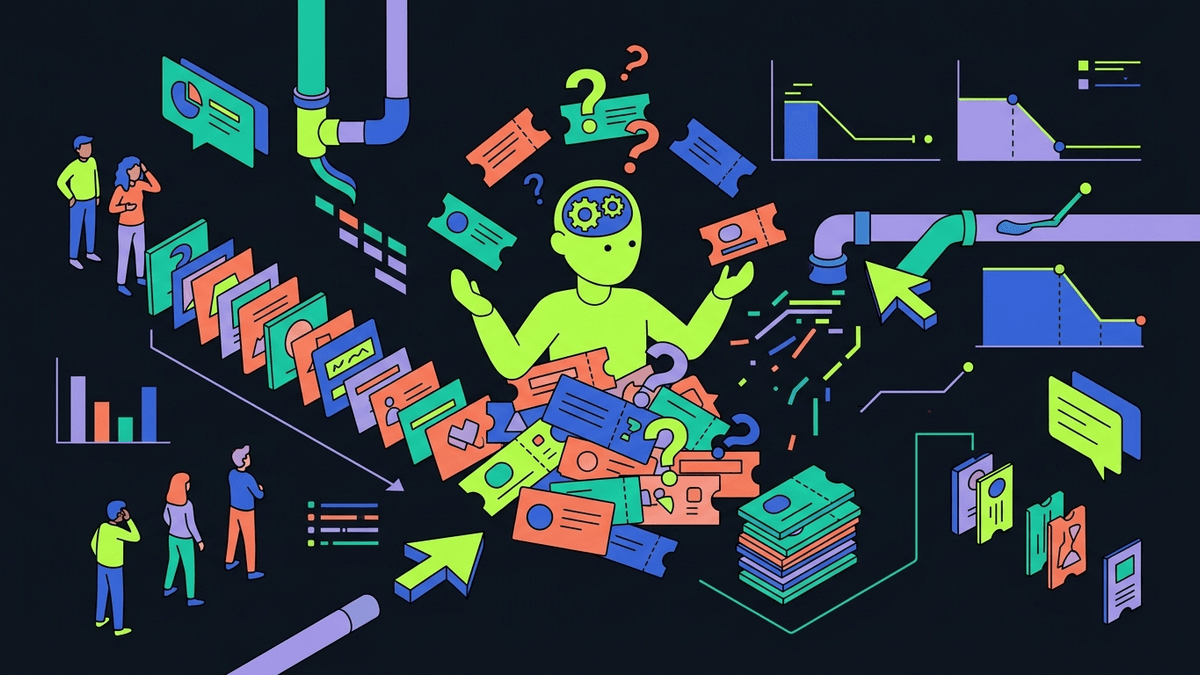
TL;DR: The adoption numbers for AI customer support look impressive because most of them measure deflection, not resolution, and those are not the same thing.
Industry surveys tend to show that a majority of support organizations have deployed some form of AI in the last two years, and vendors love to quote resolution rates in the 50-80% range. But dig into how those numbers are calculated and you'll usually find "resolved" means "the customer didn't click the escalate button," not "the customer's problem went away." That distinction is the whole ballgame, and it's why so many teams adopt an AI agent, see the dashboard numbers climb, and still get the same volume of tickets routed to humans a month later, just with worse context attached.
The Gap Between Deflection and Resolution
Deflection is easy to inflate. If a bot answers a question and the user doesn't immediately object, that often counts as a win in the vendor's reporting, even if the user gave up, found the answer themselves, or just closed the tab. Resolution means the underlying issue is actually fixed: a subscription is canceled, a password is reset, a broken integration is reconnected. We've written before about how ticket deflection hides the real metric, and the pattern holds across the industry: the more a company's AI tool only talks, the wider that gap tends to be.
A few directional patterns worth knowing if you're evaluating tools or justifying a budget:
- Cost-to-serve per ticket through traditional human support commonly runs several dollars to tens of dollars depending on complexity and channel; AI-handled tickets are cheaper per-interaction but only if they're actually closing the loop, not just adding a transcript before a human redoes the work.
- First-contact resolution for chat and in-app channels is generally lower than phone, which is counterintuitive given how much AI investment has gone into chat, and suggests the channel itself isn't the bottleneck, the action layer is.
- A large share of repeat tickets trace back to a small number of recurring stuck points, often in onboarding or billing, meaning most teams are solving the same handful of problems at scale without realizing it.
- Escalations that arrive with no context (no session, no error state, just a message) take noticeably longer to resolve than ones with full history attached, which eats back a chunk of whatever time was saved upstream.
Where AI Support Actually Fails
The common failure modes aren't exotic. They're boring, repeatable, and almost all stem from the same root cause: an AI system that can describe an action but can't take one.
- It explains how to cancel a subscription instead of canceling it.
- It hallucinates a feature or a policy because the underlying docs were stale and nobody flagged it.
- It answers confidently in a support widget that has zero visibility into what the user is actually looking at on screen.
- It escalates to a human with nothing but the last message, forcing the agent to re-ask every question the bot already asked.
Each of these is a design choice, not an inevitability. A system that only generates text will always have this ceiling, because text can't click a button or update a database row. That's the core argument we've made in what customer support automation really means: automation that doesn't touch the account isn't automation, it's a slightly more interactive FAQ page.
A Narrower, More Honest Definition of Resolved
We think "resolved" should mean the user's state changed, not that the conversation ended. That's the whole premise behind how Peeve is built: the agent lives as a cursor inside your product, so it can show the user exactly where to click when an explanation is genuinely the right move, or do the action directly with confirmation when it's not. When it genuinely can't resolve something, it doesn't just drop a transcript, it hands off a full session with the screen state, the steps already tried, and the account context, so the human isn't starting from zero.
The underlying knowledge also has to stay honest. A support agent is only as good as what it's working from, which is why we built the Brain to flag stale or contradictory docs instead of answering around them. And because stuck points repeat, stuck-point analytics matters more than another resolution percentage on a dashboard, since it tells you which five flows are generating forty percent of your volume.
If you're a support lead trying to decide whether a tool like this is worth the switch, the pricing is public and the comparison against the usual suspects is laid out plainly at how Peeve compares to Intercom Fin, Chatbase, Pendo and more, and you can see the actual cost structure at pricing before anyone gets on a call with you.
FAQ
What's the difference between AI ticket deflection and AI customer support resolution?
Deflection measures whether a ticket avoided a human agent, while resolution measures whether the customer's actual problem was fixed. A bot can deflect a ticket by giving an unhelpful answer the user doesn't challenge, which is why deflection rate alone is a weak signal of AI customer support quality.
Why does AI customer support still escalate so many tickets to humans?
Most AI customer support tools can only generate text, so anything requiring an account change, a backend lookup, or a judgment call gets routed to a human by default. Tools that can execute actions directly, with confirmation, resolve a meaningfully larger share of requests without ever reaching a human queue.
How should a support team measure whether AI customer support is actually working?
Track whether the underlying account state changed, not whether the chat window closed, and compare repeat-contact rates on the same issue before and after deployment. Stuck-point analytics that show which flows generate the most repeat tickets are a more honest signal than a single resolution percentage.